Autoencoders for Representation Learning
Interactive Deep Learning Experiment on FashionMNIST Dataset
← Backimport torch
import torch.nn as nn
import torch.optim as optim
from torchvision import datasets, transforms
from torch.utils.data import DataLoader
import matplotlib.pyplot as plt
import numpy as npimport os
import shutil
base = "/kaggle/working/FashionMNIST/raw"
os.makedirs(base, exist_ok=True)
src = "/kaggle/input/datasets/organizations/zalando-research/fashionmnist"
files = [
"train-images-idx3-ubyte",
"train-labels-idx1-ubyte",
"t10k-images-idx3-ubyte",
"t10k-labels-idx1-ubyte"
]
for f in files:
shutil.copy(
os.path.join(src, f),
os.path.join(base, f)
)
print("Files copied successfully")from torchvision import datasets, transforms
from torch.utils.data import DataLoader
transform = transforms.ToTensor()
train_data = datasets.FashionMNIST(
root="/kaggle/working",
train=True,
download=False,
transform=transform
)
test_data = datasets.FashionMNIST(
root="/kaggle/working",
train=False,
download=False,
transform=transform
)
train_loader = DataLoader(train_data, batch_size=128, shuffle=True)
test_loader = DataLoader(test_data, batch_size=128, shuffle=False)
print("Dataset loaded successfully!")
print(f"Training samples: {len(train_data)} | Test samples: {len(test_data)}")# Define class names for FashionMNIST
classes = [
'T-shirt/top', 'Trouser', 'Pullover', 'Dress', 'Coat',
'Sandal', 'Shirt', 'Sneaker', 'Bag', 'Ankle boot'
]
def display_one_from_each_class(dataset):
found_classes = {}
idx = 0
# Loop until we find one of each (0-9)
import os
import shutil
base = "/kaggle/working/FashionMNIST/raw"
os.makedirs(base, exist_ok=True)
src = "/kaggle/input/fashionmnist"
files = [
"train-images-idx3-ubyte", "train-labels-idx1-ubyte",
"t10k-images-idx3-ubyte", "t10k-labels-idx1-ubyte"
]
for f in files:
shutil.copy(os.path.join(src, f), os.path.join(base, f))
print("Files copied successfully")
while len(found_classes) < 10:
img, label = dataset[idx]
if label not in found_classes:
found_classes[label] = img
idx += 1
# Plotting
plt.figure(figsize=(15, 5))
for label, img in sorted(found_classes.items()):
plt.subplot(2, 5, label + 1)
# Convert tensor to numpy and remove channel dim for grayscale
plt.imshow(img.squeeze(), cmap='gray')
plt.title(classes[label])
plt.axis('off')
plt.tight_layout()
plt.show()
# Execute the function
display_one_from_each_class(train_data)
# Architecture: Deeper network with BatchNorm, Dropout, and 2D latent space
# Progression: 784 → 512 → 256 → 128 → 64 → 32 → 16 → 8 → 4 → 2
class Autoencoder(nn.Module):
    def __init__(self):
        super().__init__()

        # Deeper encoder: Compressing from 784 down to 2
        self.encoder = nn.Sequential(
            nn.Flatten(),
            nn.Linear(784, 512),
            nn.BatchNorm1d(512),
            nn.ReLU(),
            nn.Dropout(0.1),

            nn.Linear(512, 256),
            nn.BatchNorm1d(256),
            nn.ReLU(),

            nn.Linear(256, 128),
            nn.BatchNorm1d(128),
            nn.ReLU(),

            nn.Linear(128, 64),
            nn.BatchNorm1d(64),
            nn.ReLU(),

            nn.Linear(64, 32),
            nn.BatchNorm1d(32),
            nn.ReLU(),

            nn.Linear(32, 16),
            nn.BatchNorm1d(16),
            nn.ReLU(),

            nn.Linear(16, 8),
            nn.BatchNorm1d(8),
            nn.ReLU(),

            nn.Linear(8, 4),
            nn.BatchNorm1d(4),
            nn.ReLU(),

            nn.Linear(4, 2)  # Latent space (2D for visualization)
        )

        # Deeper decoder: Reconstructing from 2 back to 784
        self.decoder = nn.Sequential(
            nn.Linear(2, 4),
            nn.BatchNorm1d(4),
            nn.ReLU(),

            nn.Linear(4, 8),
            nn.BatchNorm1d(8),
            nn.ReLU(),

            nn.Linear(8, 16),
            nn.BatchNorm1d(16),
            nn.ReLU(),

            nn.Linear(16, 32),
            nn.BatchNorm1d(32),
            nn.ReLU(),

            nn.Linear(32, 64),
            nn.BatchNorm1d(64),
            nn.ReLU(),

            nn.Linear(64, 128),
            nn.BatchNorm1d(128),
            nn.ReLU(),

            nn.Linear(128, 256),
            nn.BatchNorm1d(256),
            nn.ReLU(),

            nn.Linear(256, 512),
            nn.BatchNorm1d(512),
            nn.ReLU(),

            nn.Linear(512, 784),
            nn.Sigmoid()  # Use Sigmoid for pixel values between [0, 1]
        )

    def forward(self, x):
        z = self.encoder(x)
        out = self.decoder(z)
        # Reshape output back to image dimensions if necessary for your loss function
        # out = out.view(-1, 1, 28, 28)
        return out, z

print("Model architecture defined successfully!")# BASIC AUTOENCODER TRAINING
# Trains on clean images only — no noise added (clean → clean)
device = torch.device("cuda" if torch.cuda.is_available() else "cpu")
basic_model = Autoencoder().to(device)
criterion_mse = nn.MSELoss()
criterion_l1 = nn.L1Loss()
optimizer_basic = optim.Adam(basic_model.parameters(), lr=0.001)
scheduler_basic = optim.lr_scheduler.ReduceLROnPlateau(optimizer_basic, mode='min', patience=5)
epochs = 100
best_loss_basic = float('inf')
for epoch in range(epochs):
basic_model.train()
total_loss = 0
for images, _ in train_loader:
images = images.to(device)
outputs, _ = basic_model(images)
loss_mse = criterion_mse(outputs, images.view(images.size(0), -1))
loss_l1 = criterion_l1(outputs, images.view(images.size(0), -1))
loss = 0.7 * loss_mse + 0.3 * loss_l1
optimizer_basic.zero_grad()
loss.backward()
torch.nn.utils.clip_grad_norm_(basic_model.parameters(), max_norm=1.0)
optimizer_basic.step()
total_loss += loss.item()
avg_loss = total_loss / len(train_loader)
scheduler_basic.step(avg_loss)
if avg_loss < best_loss_basic:
best_loss_basic = avg_loss
if (epoch + 1) % 5 == 0:
print(f"Epoch [{epoch+1}/{epochs}] Loss: {avg_loss:.4f}")
print(f"\nTraining completed! Best Loss: {best_loss_basic:.4f}")# VISUALIZATION: BASIC RECONSTRUCTION
# Display original and reconstructed images side-by-side (no noise — clean input only)
basic_model.eval()
images, _ = next(iter(test_loader))
images = images.to(device)
with torch.no_grad():
reconstructed_basic, _ = basic_model(images)
# Display 8 samples
n = 8
plt.figure(figsize=(12, 4))
for i in range(n):
# Original
plt.subplot(2, n, i+1)
plt.imshow(images[i].cpu().squeeze(), cmap='gray')
plt.axis('off')
# Reconstructed
plt.subplot(2, n, i+1+n)
plt.imshow(reconstructed_basic[i].view(28,28).cpu(), cmap='gray')
plt.axis('off')
plt.tight_layout()
plt.show()
print("Basic reconstruction visualization completed!")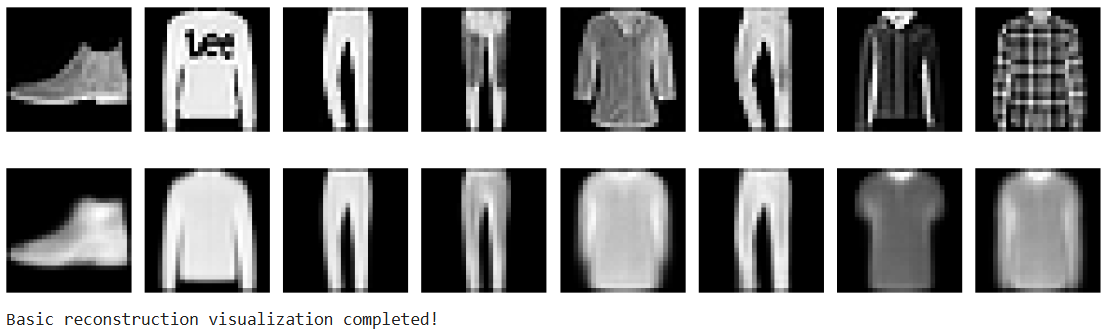
# DENOISING AUTOENCODER TRAINING
# Uses combined MSE + L1 loss with gradient clipping
# Trains on noisy images, reconstructs clean ones (noisy → clean)

def add_noise(x, noise_factor=0.25):
    noisy = x + noise_factor * torch.randn_like(x)
    return torch.clamp(noisy, 0., 1.)

device = torch.device("cuda" if torch.cuda.is_available() else "cpu")
model = Autoencoder().to(device)

criterion_mse = nn.MSELoss()
criterion_l1 = nn.L1Loss()
optimizer = optim.Adam(model.parameters(), lr=0.001)
scheduler = optim.lr_scheduler.ReduceLROnPlateau(optimizer, mode='min', patience=5)

epochs = 100
best_loss = float('inf')

print("Starting denoising autoencoder training...")

for epoch in range(epochs):
    model.train()
    total_loss = 0

    for images, _ in train_loader:
        images = images.to(device)
        noisy = add_noise(images)
        outputs, _ = model(noisy)

        loss_mse = criterion_mse(outputs, images.view(images.size(0), -1))
        loss_l1 = criterion_l1(outputs, images.view(images.size(0), -1))
        loss = 0.7 * loss_mse + 0.3 * loss_l1

        optimizer.zero_grad()
        loss.backward()
        torch.nn.utils.clip_grad_norm_(model.parameters(), max_norm=1.0)
        optimizer.step()

        total_loss += loss.item()

    avg_loss = total_loss / len(train_loader)
    scheduler.step(avg_loss)

    if avg_loss < best_loss:
        best_loss = avg_loss

    if (epoch + 1) % 5 == 0:
        print(f"Epoch [{epoch+1}/{epochs}] Loss: {avg_loss:.4f}")

print(f"\nTraining completed! Best Loss: {best_loss:.4f}")
# VISUALIZATION: BASIC RECONSTRUCTION
# Display original, noisy, and reconstructed images side-by-side

model.eval()
images, _ = next(iter(test_loader))
images = images.to(device)
noisy = add_noise(images)

with torch.no_grad():
    reconstructed, _ = model(noisy)

# Display 8 samples
n = 8
plt.figure(figsize=(12, 5))

for i in range(n):
    # Original
    plt.subplot(3, n, i+1)
    plt.imshow(images[i].cpu().squeeze(), cmap='gray')
    plt.axis('off')

    # Noisy
    plt.subplot(3, n, i+1+n)
    plt.imshow(noisy[i].cpu().squeeze(), cmap='gray')
    plt.axis('off')

    # Reconstructed
    plt.subplot(3, n, i+1+2*n)
    plt.imshow(reconstructed[i].view(28,28).cpu(), cmap='gray')
    plt.axis('off')

plt.tight_layout()
plt.show()

print("Reconstruction visualization completed!")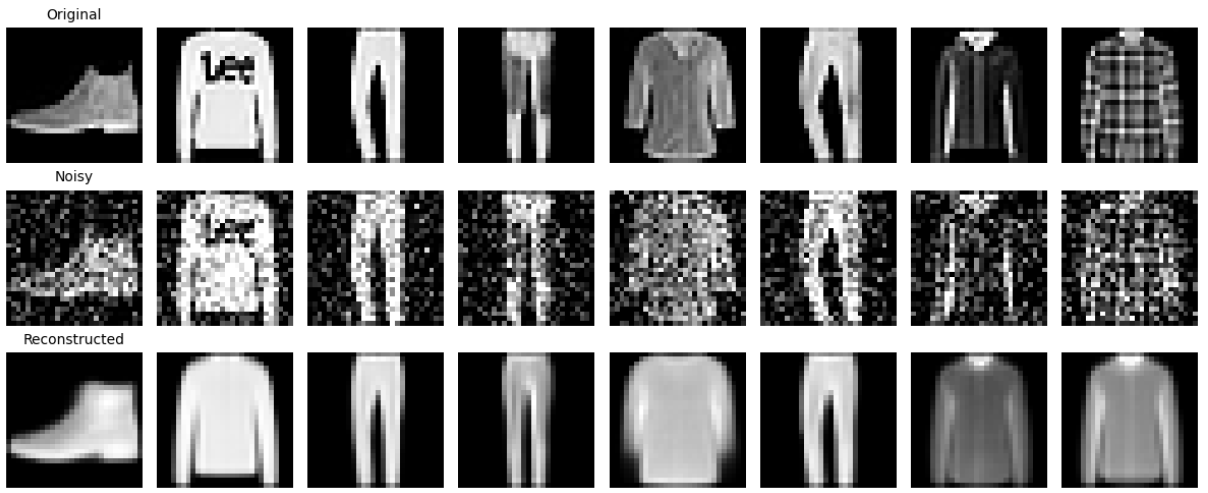
# ============================================================================
# VISUALIZATION : NOISE ROBUSTNESS TEST
# Tests model performance at different noise levels (0.1 to 0.6)
# Shows how well the model handles varying amounts of noise
# ============================================================================
import random

img_idx = random.randint(0, images.size(0) - 1)
noise_levels = [0.1, 0.25, 0.4, 0.6]

plt.figure(figsize=(12, 8))

for i, nf in enumerate(noise_levels):
    noisy_test = add_noise(images, nf)
    with torch.no_grad():
        recon, _ = model(noisy_test)

    # Original
    plt.subplot(len(noise_levels), 3, i*3 + 1)
    plt.imshow(images[img_idx].cpu().squeeze(), cmap='gray')
    plt.axis('off')
    if i == 0:
        plt.title('Original', fontsize=10)
    plt.ylabel(f'Noise={nf}', fontsize=9)

    # Noisy
    plt.subplot(len(noise_levels), 3, i*3 + 2)
    plt.imshow(noisy_test[img_idx].cpu().squeeze(), cmap='gray')
    plt.axis('off')
    if i == 0:
        plt.title('Noisy Input', fontsize=10)

    # Reconstructed
    plt.subplot(len(noise_levels), 3, i*3 + 3)
    plt.imshow(recon[img_idx].view(28,28).cpu(), cmap='gray')
    plt.axis('off')
    if i == 0:
        plt.title('Reconstructed', fontsize=10)

plt.suptitle('Denoising Performance at Different Noise Levels', fontsize=12)
plt.tight_layout()
plt.savefig('noise_comparison.png', dpi=150, bbox_inches='tight')
plt.show()

print("Noise robustness test completed!")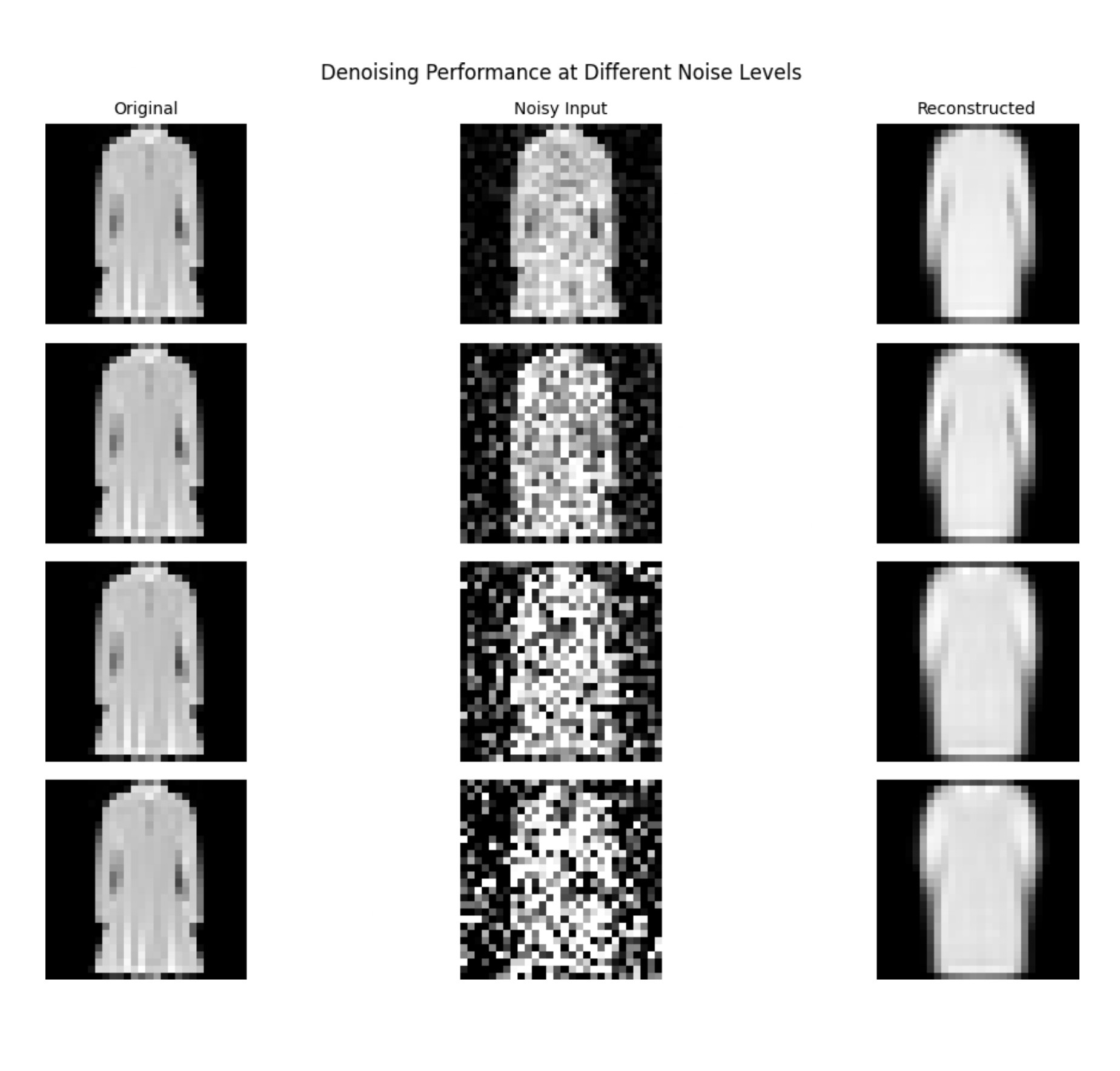
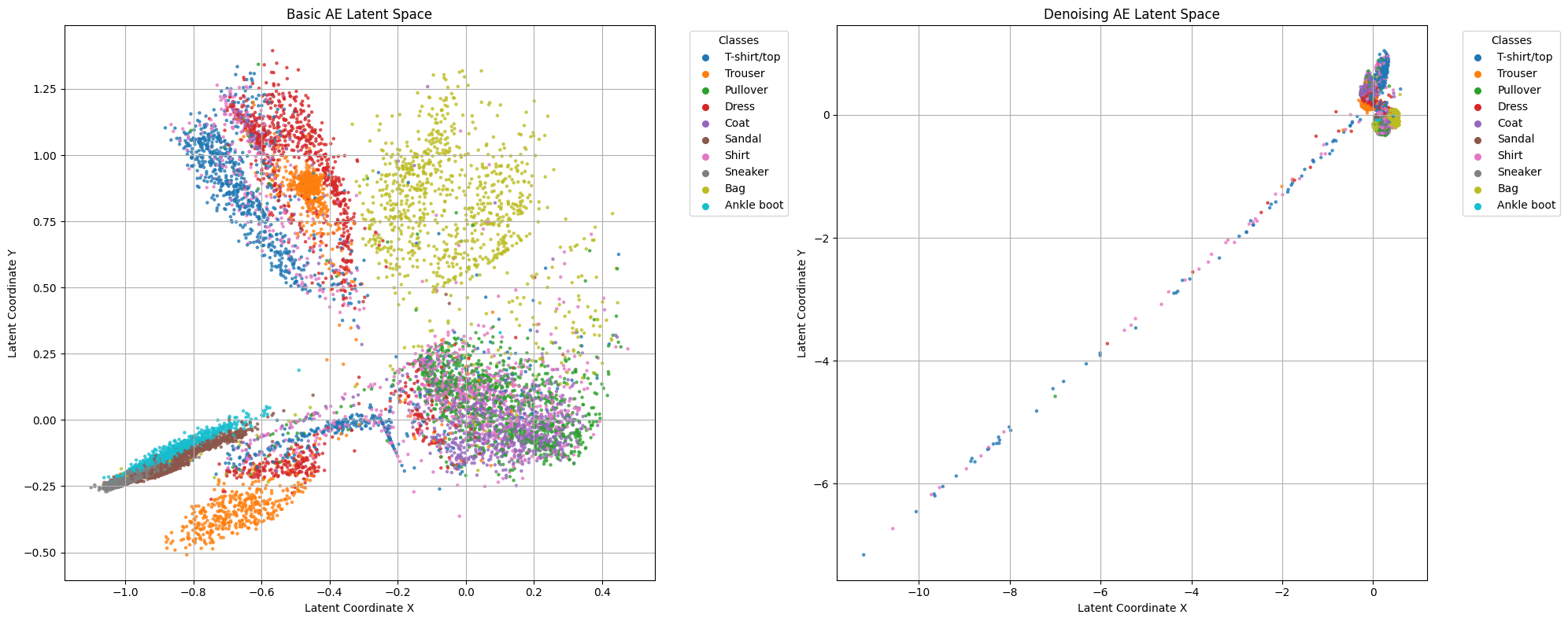
def get_latents(mdl, loader):
    latents, labels = [], []
    with torch.no_grad():
        for images, lbls in loader:
            images = images.to(device)
            _, z = mdl(images)
            latents.append(z.cpu())
            labels.append(lbls)
    return torch.cat(latents).numpy(), torch.cat(labels).numpy()

class_names = [
    "T-shirt/top", "Trouser", "Pullover", "Dress", "Coat",
    "Sandal", "Shirt", "Sneaker", "Bag", "Ankle boot"
]

basic_latents, labels = get_latents(basic_model, test_loader)
denoise_latents, _ = get_latents(model, test_loader)

fig, axes = plt.subplots(1, 2, figsize=(20, 8))

for ax, latents, title in zip(axes,
                               [basic_latents, denoise_latents],
                               ["Basic AE Latent Space", "Denoising AE Latent Space"]):
    scatter = ax.scatter(latents[:, 0], latents[:, 1], c=labels, cmap='tab10', s=5, alpha=0.7)
    handles = [ax.scatter([], [], c=[scatter.cmap(scatter.norm(i))], label=class_names[i], s=30)
               for i in range(len(class_names))]
    ax.legend(handles=handles, title="Classes", bbox_to_anchor=(1.05, 1), loc='upper left')
    ax.set_xlabel("Latent Coordinate X")
    ax.set_ylabel("Latent Coordinate Y")
    ax.set_title(title)
    ax.grid(True)

plt.tight_layout()
plt.show()

print("Latent space visualization completed!")
def calculate_ssim(img1, img2):
    C1, C2 = 0.01 ** 2, 0.03 ** 2
    mu1, mu2 = img1.mean(), img2.mean()
    sigma1_sq = ((img1 - mu1) ** 2).mean()
    sigma2_sq = ((img2 - mu2) ** 2).mean()
    sigma12 = ((img1 - mu1) * (img2 - mu2)).mean()
    return (((2 * mu1 * mu2 + C1) * (2 * sigma12 + C2)) /
           ((mu1 ** 2 + mu2 ** 2 + C1) * (sigma1_sq + sigma2_sq + C2))).item()

def evaluate_model(mdl, loader, use_noise=False):
    mdl.eval()
    total_mse = total_ssim = total_psnr = total_samples = 0

    with torch.no_grad():
        for images, _ in loader:
            images = images.to(device)
            inputs = add_noise(images) if use_noise else images
            outputs, _ = mdl(inputs)
            outputs = outputs.view_as(images)

            for i in range(images.size(0)):
                mse = ((outputs[i] - images[i]) ** 2).mean().item()
                total_mse += mse
                # Safe PSNR: clamp MSE to avoid log(0)
                total_psnr += 20 * np.log10(1.0 / np.sqrt(max(mse, 1e-10)))
                total_ssim += calculate_ssim(images[i].squeeze(), outputs[i].squeeze())
                total_samples += 1

    return {
        "MSE": total_mse / total_samples,
        "PSNR": total_psnr / total_samples,
        "SSIM": total_ssim / total_samples
    }

# Evaluate both models
basic_metrics = evaluate_model(basic_model, test_loader, use_noise=False)
denoise_metrics = evaluate_model(model, test_loader, use_noise=True)

print("Quantitative Evaluation Results:")
print(f"{'Metric':<10} {'Basic AE':>12} {'Denoising AE':>14}")
print("-" * 38)
for metric in ["MSE", "PSNR", "SSIM"]:
    unit = " dB" if metric == "PSNR" else ""
    print(f"{metric:<10} {basic_metrics[metric]:>11.4f}{unit}  {denoise_metrics[metric]:>11.4f}{unit}")